English
 Français
 Español
 русский
 عربى
Green Ohm
Green Ohm
Green Ohm
Green Ohm
Green Ohm
Green Ohm
Green Ohm
Green Ohm
Green Ohm
Content
- 1 Why Cable Sheathing Materials Matter in Fire Safety
- 2 Product Composition and Functional Design
- 3 Core Performance Advantages
- 4 Typical Technical Data
- 5 Advantages Compared with Conventional or Less-Optimized Compounds
- 6 Advanced Manufacturing and Twin-Screw Compounding
- 7 Manufacturing Strengths and Research Capability
- 8 Applications Across Multiple Cable Industries
- 9 Processing Considerations for Cable Manufacturers
- 10 Quality Control and Customer Support
- 11 How to Select Between B1 and B2 Grades
- 12 Sustainability and Safety Value
- 13 Frequently Asked Questions
- 13.1 What are B1 and B2 LSZH sheathing materials?
- 13.2 What is the main advantage of this product?
- 13.3 Does the material contain halogens?
- 13.4 What oxygen index values are reported?
- 13.5 How does the product perform in smoke-density testing?
- 13.6 Is the compound suitable for outdoor cables?
- 13.7 Can the material be used for railway or marine cables?
- 13.8 How is the compound manufactured?
- 13.9 What is the tensile strength and elongation at break?
- 13.10 Does the material resist thermal aging?
- 13.11 What information should be confirmed before purchasing?
- 13.12 Where is the manufacturer located?
- 13.13 How can customers contact the supplier?
- 14 Conclusion
- 15 References
- 16 Product: B1 and B2 low smoke halogen-free sheathing materials
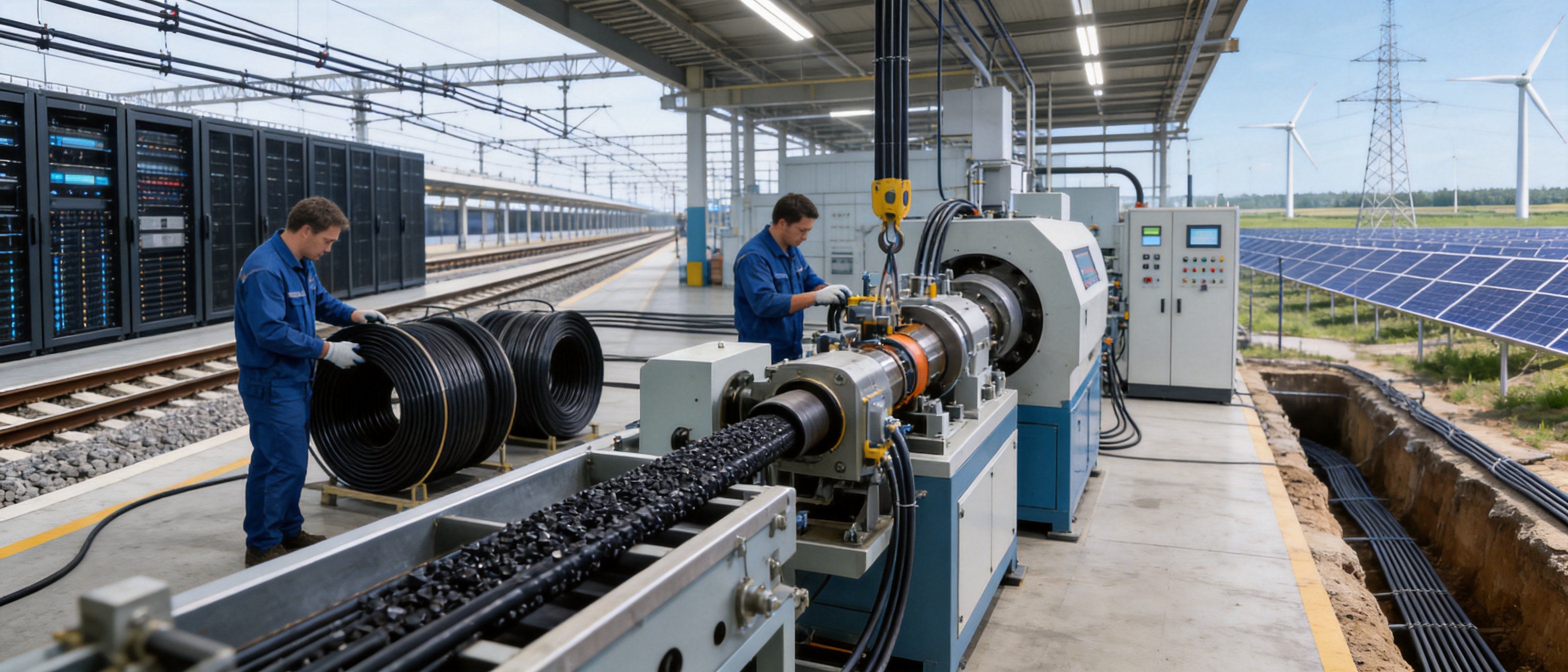
Modern cable systems must do more than transmit power or data. They must also help protect people, buildings, equipment, and critical infrastructure when exposed to fire. In transportation facilities, commercial buildings, communication networks, renewable-energy installations, industrial plants, and public infrastructure, cable sheathing plays an important role in controlling flame spread, smoke generation, corrosive emissions, and mechanical failure. The development of low-smoke halogen-free, or LSZH, compounds has therefore become a major priority for cable manufacturers seeking improved fire safety and more sustainable material solutions.
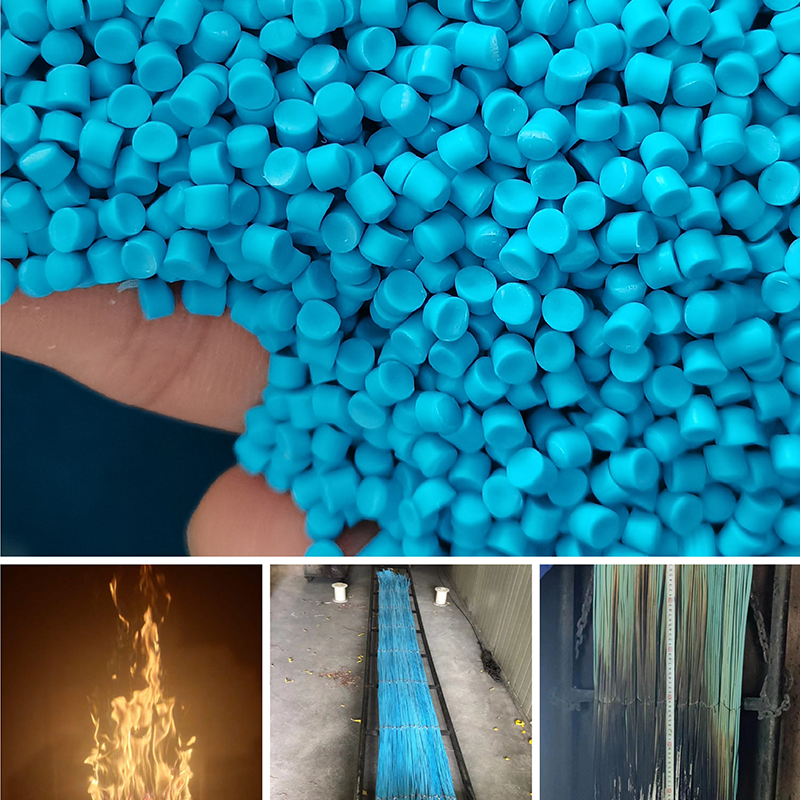
B1 and B2 low-smoke halogen-free sheathing materials are engineered to meet demanding flame-retardant and smoke-performance requirements while retaining the mechanical and electrical properties needed for reliable cable production. The material described in this article is a polyolefin-based compound formulated with complex high-efficiency flame retardants, flame-retardant synergists, carbonization agents, antioxidants, and carefully selected additives. It is compounded and granulated through twin-screw processing to provide a consistent material suitable for cables of various specifications.
The compound is designed to deliver high flame retardancy, reduced smoke toxicity, low corrosiveness, resistance to dripping, resistance to cracking, and stable processing performance. It is intended for applications requiring compliance with the B1 and B2 classification combustion standards described in GB 31247-2014, as well as the B1ca, B2ca, and Cca classification levels referenced in EN 13501-6. The available product series includes DS-WDZH-B1, DS-WDZH-X-B1, DS-WDZH-W-B1, and DS-WDZH-B2, allowing cable manufacturers to select a formulation according to application requirements.
Why Cable Sheathing Materials Matter in Fire Safety
Cable insulation and sheathing are often installed throughout a building or infrastructure system. They may run through walls, ceilings, shafts, tunnels, equipment rooms, data centers, railway cars, power stations, and enclosed public areas. During a fire, conventional halogen-containing materials can contribute to dense smoke and corrosive gases. These emissions may reduce visibility, hinder evacuation, damage electronic equipment, and complicate firefighting operations.
LSZH cable compounds are developed to address these risks. When appropriately formulated and correctly processed, they can significantly reduce the release of halogen-based acidic gases and support lower smoke production. The absence or limitation of halogen-containing components also helps reduce corrosive emissions. These characteristics are particularly valuable where people may need to evacuate quickly or where sensitive electrical and electronic systems must remain protected from aggressive combustion byproducts.
Fire performance is not determined by a single property. A high-quality sheathing material must balance several requirements at the same time. It needs to resist ignition and flame propagation, maintain adequate tensile strength and elongation, avoid cracking during thermal exposure, show acceptable low-temperature behavior, and preserve electrical insulation performance. It must also be suitable for industrial extrusion, allowing cable manufacturers to produce smooth and uniform sheaths at practical speeds.
The B1 and B2 LSZH sheathing materials address this multi-property challenge through a combination of polymer selection, flame-retardant chemistry, synergistic additives, carbonization technology, antioxidant protection, and controlled compounding. Instead of relying on one additive to provide all fire-related properties, the formulation uses complementary mechanisms that work together during combustion and thermal exposure.
Product Composition and Functional Design
The base polymer is a polyolefin resin. Polyolefins are widely used in cable compounds because they can provide a useful combination of processability, flexibility, chemical resistance, electrical insulation, and mechanical strength. The resin forms the continuous matrix of the compound, while the other components are dispersed throughout the matrix to create the desired flame-retardant and environmental performance.
Complex high-efficiency flame retardants are incorporated to reduce the tendency of the material to sustain combustion and propagate flame. These flame retardants may act through several mechanisms, including heat absorption, dilution of combustible gases, formation of protective residues, and interruption of combustion reactions. Their efficiency is important because excessive additive loading can negatively affect mechanical properties, surface appearance, processability, or cable flexibility.
Flame-retardant synergists support and strengthen the primary flame-retardant system. A synergist can improve the performance of the formulation without requiring a proportional increase in the main flame-retardant content. This approach helps the compound achieve the intended fire classification while preserving a more balanced set of physical properties.
Carbonization agents encourage the formation of a protective char layer when the material is exposed to high temperatures or flame. A stable carbonized layer can act as a barrier between the heat source and the underlying polymer. It can also reduce the escape of combustible decomposition products and limit the exchange of oxygen at the material surface. This protective action contributes to improved resistance to flame spread and dripping.
Antioxidants are used to help protect the polyolefin matrix during processing and service. Cable compounds pass through elevated-temperature extrusion equipment, and the polymer may be exposed to heat, shear, and oxygen. Antioxidant protection helps reduce thermo-oxidative degradation, supporting stable processing and long-term property retention.
Additional processing and performance additives are selected to support dispersion, surface quality, extrusion behavior, thermal stability, and finished-cable reliability. Because LSZH formulations contain substantial mineral or functional additive content, uniform distribution is essential. Poor dispersion can create weak points, surface defects, inconsistent fire behavior, and variations in electrical performance.
Core Performance Advantages
High Flame Retardancy
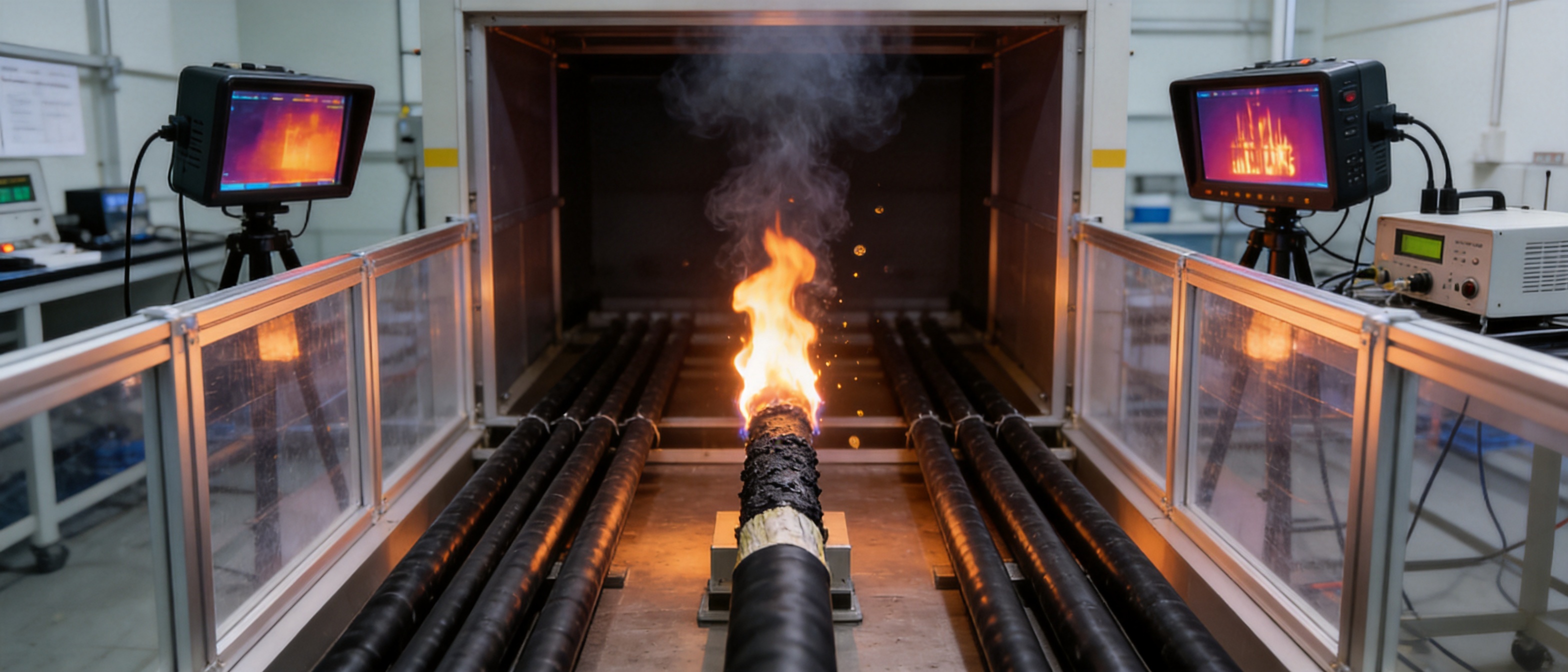
The principal purpose of the B1 and B2 formulations is to provide high flame-retardant performance for cable sheathing applications. The material is designed to satisfy the stated B1 and B2 classification combustion requirements under GB 31247-2014 and to support the B1ca, B2ca, and Cca classification levels described in EN 13501-6. Actual classification depends on the complete cable construction, processing conditions, testing configuration, and applicable certification procedures, but the compound is developed specifically for these demanding performance targets.
The reported oxygen index values demonstrate the flame-retardant design of the material. The standard requirement is listed as at least 30 percent, while typical values for the product variants range from 38 to 42 percent. A higher oxygen index generally indicates that a material requires a higher oxygen concentration to sustain combustion under the specified test method. The values recorded for these formulations show a meaningful margin above the listed requirement.
High oxygen index performance is only one part of the overall fire-safety profile. The formulation also targets resistance to dripping, low smoke density, stable thermal behavior, and reduced corrosiveness. This combined approach is more useful for cable applications than focusing on a single isolated fire property.
Low Smoke Generation
Smoke can be one of the most dangerous consequences of a cable fire. Dense smoke can obscure escape routes, make signage difficult to see, impair breathing, and delay emergency response. Low-smoke cable compounds are therefore important in enclosed or occupied environments, including public buildings, transportation systems, data centers, hospitals, tunnels, and industrial facilities.
The typical flaming smoke-density values reported for the four product variants range from 62 to 75, against a listed limit of 100. The typical flameless smoke-density values range from 198 to 223, against a listed limit of 350. These results indicate that the formulations are designed to maintain low smoke generation under both flaming and flameless test conditions.
Smoke performance is influenced by resin chemistry, additive selection, filler dispersion, test configuration, and finished cable design. A compound with good smoke performance gives cable manufacturers a strong material foundation, but the final cable should still be evaluated as a complete product under the relevant testing standard.
Reduced Corrosive and Acid Gas Emissions
Low-smoke halogen-free technology is particularly valuable because combustion emissions are not assessed only by their visual density. The chemical nature of the smoke and gases is also important. Acidic or corrosive gases can attack metal conductors, connectors, control systems, circuit boards, and other electronic components. They can also create hazardous conditions for people in enclosed spaces.
The product information lists a pH requirement of at least 4.3, with typical values of 5.1 to 5.2. It also lists HCl and HBr content below 0.5 percent for all reported variants. Conductivity is listed at 1.1 μS/mm, comfortably below the stated limit of 10 μS/mm. These results support the formulation’s low-corrosiveness design and its suitability for applications where smoke toxicity and corrosive emissions are important considerations.
The term halogen-free is commonly used in the cable industry to describe materials designed to limit halogen-based emissions under combustion conditions. Cable manufacturers should confirm the exact test method, declaration requirements, and regulatory interpretation applicable to their target market.
Resistance to Dripping and Cracking
Flaming droplets can create secondary ignition points and spread fire to lower levels or adjacent materials. For this reason, a flame-retardant sheathing compound must be designed not only to resist flame spread but also to limit dripping behavior. The product description specifically identifies resistance to dripping as one of its intended performance characteristics.
Thermal cracking is another critical concern. A sheath that cracks during thermal shock or sustained heat exposure may expose the underlying insulation, shielding, or conductor. The reported thermal shock resistance result is “no cracking” for all four product variants. The ozone resistance test also reports “no cracking,” indicating that the formulations are designed to maintain surface integrity under the stated test conditions.
Crack resistance is especially important in cables that experience bending, vibration, temperature changes, outdoor exposure, or installation stress. The final result depends on compound selection, extrusion quality, cooling conditions, cable geometry, and installation practices, but the material’s reported performance provides a strong basis for reliable sheath design.
Balanced Mechanical Properties
Fire-retardant additives can sometimes reduce flexibility or elongation if the formulation is not carefully engineered. The reported tensile strength for all four product variants is 12 MPa, compared with a listed minimum requirement of 10 MPa. Elongation at break is reported at 170 percent, compared with a minimum requirement of 160 percent.
These values show that the compound is not designed around flame retardancy alone. It also provides a balanced mechanical profile suitable for cable sheathing. Tensile strength supports resistance to handling and installation forces, while elongation helps the sheath accommodate bending, movement, and dimensional changes without premature rupture.
The combination of adequate tensile strength and high elongation is particularly useful for cables that must be routed through limited spaces or installed around bends. It may also support improved resistance to damage during manufacturing, transportation, pulling, and service.
Thermal Aging Stability
Cable compounds can experience significant thermal exposure during extrusion and throughout their service life. The reported air thermal aging test is conducted at 100°C for 168 hours. The listed requirement for tensile-strength and elongation change is within plus or minus 25 percent. The typical tensile-strength changes range from plus 7 to plus 11 percent, while the typical elongation changes range from minus 5 to minus 10 percent.
These changes remain within the stated limits and indicate that the material retains its mechanical properties after the specified aging treatment. Thermal aging stability is important because gradual embrittlement or excessive softening can shorten cable life and increase the risk of sheath damage.
The reported thermal denaturation values range from 9 to 11 percent, compared with a maximum requirement of 50 percent. This result indicates low dimensional change under the listed test condition. Dimensional stability helps support consistent cable geometry and reduces the risk of deformation during processing or service.
Electrical Insulation Performance
Although the principal focus of these materials is flame-retardant sheathing, electrical performance remains important. The reported volume resistivity at 20°C ranges from 1.3 × 10¹³ to 1.5 × 10¹³ Ω·cm, compared with a listed standard value of 1.0 × 10¹² Ω·cm. High volume resistivity supports electrical isolation and helps reduce leakage-current risks under appropriate cable designs.
Electrical performance may be affected by additive distribution, moisture, processing temperature, cooling conditions, and the interaction between the sheath and other cable components. Stable compounding and proper extrusion are therefore essential to achieving the expected performance in production.
Low-Temperature Performance
Cables may be installed or operated in cold environments, including outdoor facilities, transportation systems, renewable-energy projects, and industrial installations. A low-temperature brittleness temperature of -25°C is listed for the product, with all four variants passing the stated test.
Low-temperature resistance helps reduce the risk of cracking during cold-weather handling and service. It is particularly relevant when cables must be pulled, bent, or installed during winter conditions. The exact minimum operating temperature of a finished cable should be established through complete cable testing rather than inferred from the compound data alone.
Typical Technical Data
The following table summarizes the typical values supplied for DS-WDZH-B1, DS-WDZH-X-B1, DS-WDZH-W-B1, and DS-WDZH-B2. These values are representative rather than a substitute for a formal product specification, certificate, or batch-specific quality document.
| No. | Item | Unit | Standard or Requirement | DS-WDZH-B1 | DS-WDZH-X-B1 | DS-WDZH-W-B1 | DS-WDZH-B2 |
|---|---|---|---|---|---|---|---|
| 1 | Density | g/cm³ | Not specified | 1.56 | 1.57 | 1.56 | 1.54 |
| 2 | Tensile strength | MPa | ≥10.0 | 12 | 12 | 12 | 12 |
| 3 | Elongation at break | % | ≥160 | 170 | 170 | 170 | 170 |
| 4 | Oxygen index | % | ≥30 | 38 | 40 | 42 | 38 |
| 5 | Tensile-strength change after air aging at 100°C for 168 hours | % | ±25 | +10 | +8 | +7 | +11 |
| 6 | Elongation change after air aging at 100°C for 168 hours | % | ±25 | -7 | -6 | -5 | -10 |
| 7 | Thermal denaturation | % | ≤50 | 10 | 9 | 9 | 11 |
| 8 | Thermal shock resistance | / | No cracking | No cracking | No cracking | No cracking | No cracking |
| 9 | Smoke density, flaming | / | ≤100 | 70 | 67 | 62 | 75 |
| 10 | Smoke density, flameless | / | ≤350 | 210 | 206 | 198 | 223 |
| 11 | Volume resistivity at 20°C | Ω·cm | 1.0 × 10¹² | 1.4 × 10¹³ | 1.4 × 10¹³ | 1.3 × 10¹³ | 1.5 × 10¹³ |
| 12 | Ozone resistance | / | No cracking | No cracking | No cracking | No cracking | No cracking |
| 13 | Low-temperature brittleness | °C | -25 | Pass | Pass | Pass | Pass |
| 14 | pH | / | ≥4.3 | 5.2 | 5.1 | 5.2 | 5.1 |
| 15 | HCl and HBr content | % | ≤0.5 | <0.5 | <0.5 | <0.5 | <0.5 |
| 16 | Conductivity | μS/mm | ≤10 | 1.1 | 1.1 | 1.1 | 1.1 |
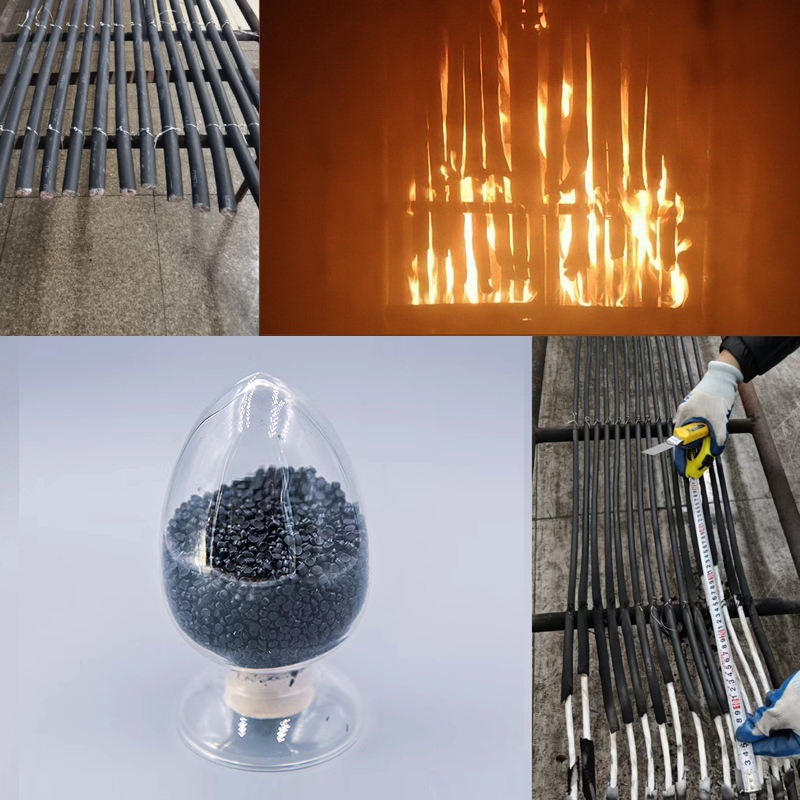
B1 and B2 low smoke halogen-free sheathing materials
Advantages Compared with Conventional or Less-Optimized Compounds
The value of an LSZH cable compound should be assessed across the complete performance profile rather than through a single marketing claim. Compared with conventional halogen-containing sheathing systems, a well-designed LSZH compound can provide a lower-corrosiveness combustion profile and improved suitability for smoke-sensitive environments. Compared with poorly balanced halogen-free compounds, a high-quality formulation should provide better mechanical retention, surface integrity, process stability, and predictable fire performance.
One important advantage of the product is its balanced combination of fire and mechanical properties. The reported oxygen index values exceed the listed minimum, while tensile strength and elongation also exceed their respective requirements. This balance helps address a common challenge in flame-retardant cable materials: increasing flame resistance without making the sheath excessively brittle or difficult to process.
A second advantage is the low smoke profile under both flaming and flameless conditions. The typical values remain below the listed limits by significant margins. This provides cable designers with a material option suitable for applications in which smoke visibility and evacuation safety are major concerns.
A third advantage is the reported resistance to thermal shock and ozone cracking. These properties support applications that involve temperature variation, outdoor exposure, vibration, or long-term environmental stress. No material can eliminate the need for correct cable design, but resistance to cracking creates an important reliability margin.
A fourth advantage is the combination of low corrosiveness and electrical insulation. The pH, acid-gas, conductivity, and volume-resistivity results indicate that the formulation is designed to support both fire safety and electrical reliability. This is important because a cable sheath must function as part of a complete electrical system, not simply as a flame-retardant outer layer.
A fifth advantage is product-family flexibility. The four listed variants provide options within the B1 and B2 material range. Different cable designs may require different balances of flame performance, process behavior, mechanical response, and application characteristics. A product family allows cable manufacturers to evaluate the most suitable grade rather than forcing every application into one general-purpose compound.
Advanced Manufacturing and Twin-Screw Compounding
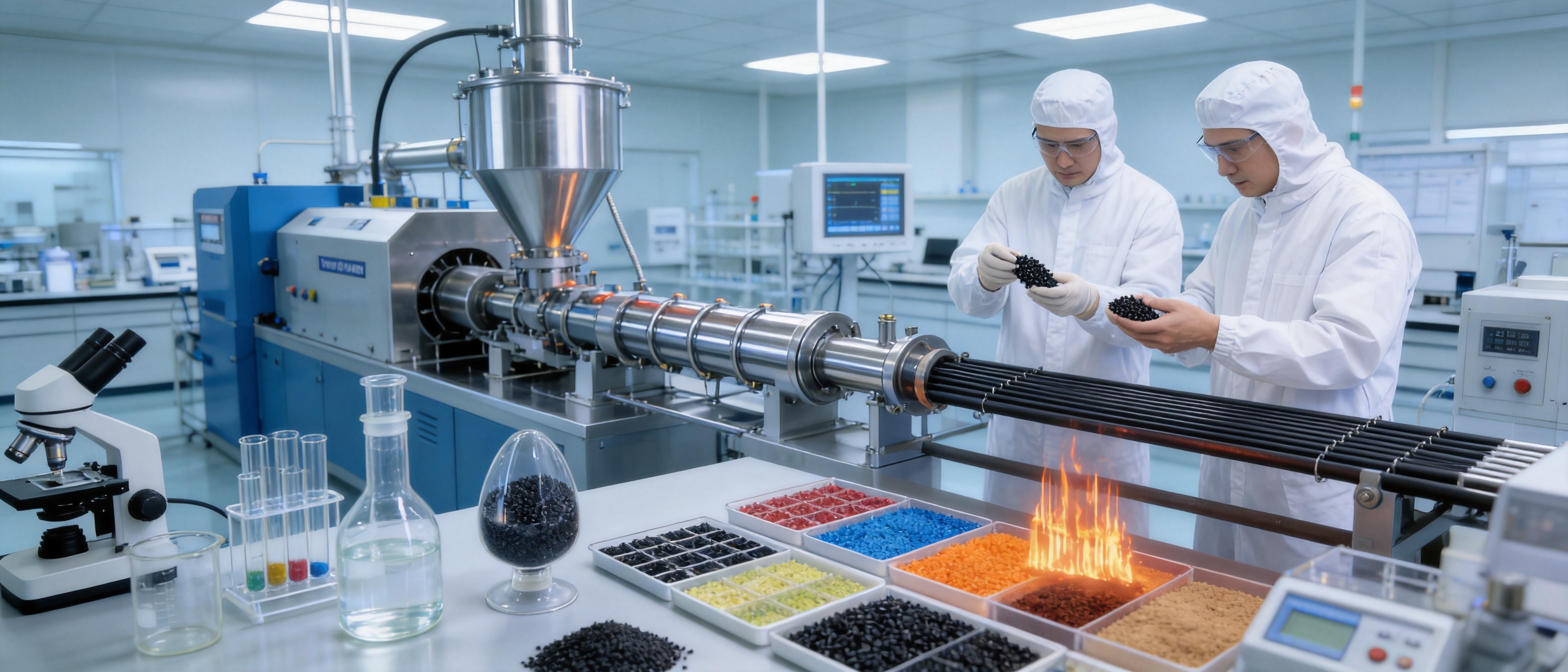
The manufacturing process is fundamental to the performance of any filled and flame-retardant polymer compound. The formulation is mixed and granulated through twin-screw extrusion. Twin-screw technology is widely used for complex polymer compounding because it provides controlled feeding, intensive distributive and dispersive mixing, residence-time management, temperature control, and efficient granulation.
In the first stage, the raw materials are selected and prepared according to the formulation. Polyolefin resin, flame retardants, synergists, carbonization agents, antioxidants, and additives must be weighed accurately. Consistent raw-material handling helps maintain batch-to-batch uniformity and reduces variation in density, melt behavior, flame performance, smoke generation, and mechanical properties.
During compounding, the polymer matrix is melted under controlled temperature and shear conditions. The additives are introduced according to the process design so that they can be distributed throughout the resin. Excessive shear or heat may degrade the polymer or certain additives, while insufficient mixing may produce agglomerates and nonuniform performance. A properly configured twin-screw line allows the processor to establish a controlled balance between mixing intensity and thermal protection.
After homogeneous mixing, the compound is shaped into pellets. Granulation provides a convenient and consistent feedstock for cable extrusion. Uniform pellet size supports stable feeding, predictable melting, and more consistent output. It also simplifies packaging, storage, transportation, and automated production-line handling.
Process control may include monitoring of feeding accuracy, melt temperature, torque, pressure, screw speed, residence time, cooling conditions, pellet dimensions, and visual quality. These controls are especially important for LSZH compounds because high additive loading can influence viscosity, heat transfer, die pressure, and surface finish.
Quality assurance should continue after pelletizing. Typical evaluation may include density, tensile strength, elongation, oxygen index, thermal aging, thermal shock, smoke density, electrical resistivity, low-temperature brittleness, pH, acid-gas content, and conductivity. The technical data supplied for this product demonstrates that the material is assessed across a broad range of physical, thermal, fire, chemical, and electrical characteristics.
Manufacturing Strengths and Research Capability
Jiangsu Duoshang New Materials Technology Co., Ltd. specializes in the research, development, production, and sale of polyolefin cable compounds. The company operates a research and development center of more than 3,000 square meters. The center is equipped with research equipment valued at more than RMB 35 million and supported by a professional team of more than 30 research personnel, including five doctors and other recipients of provincial and municipal talent awards.
This research structure supports application-oriented development. Cable compounds must be optimized for actual extrusion, cable construction, regulatory testing, environmental exposure, and customer production requirements. A dedicated research center can help connect laboratory formulation work with pilot testing, process evaluation, and product-scale manufacturing.
The company operates two production bases covering more than 15,000 square meters and has more than 10 production lines for polyolefin cable compounds. This manufacturing footprint provides a foundation for stable supply, product-family development, and production scheduling across different cable-compound categories.
The portfolio includes more than 50 varieties in eight major categories. These include ultraviolet-crosslinked compounds, silane cross-linkable compounds, irradiation cross-linked compounds, thermoplastic low-smoke halogen-free flame-retardant compounds, polyethylene sheath compounds, and other specialized cable materials. Such breadth is useful because cable manufacturers may require several compound technologies across different product lines.
Manufacturing scale is valuable only when supported by process discipline and technical control. For customers, the practical advantages may include more reliable supply planning, improved ability to support customized formulations, access to technical documentation, and better coordination between development samples and mass production. The company’s stated focus on polymer cable compounds and biodegradable materials also indicates an ongoing commitment to material innovation.
Applications Across Multiple Cable Industries
Power Cables
Power-cable systems require sheathing materials that can withstand mechanical handling, environmental exposure, thermal stress, and electrical-service conditions. LSZH sheathing can be especially valuable in substations, power distribution facilities, commercial buildings, and enclosed electrical rooms where smoke and corrosive emissions must be limited.
Communication and Data Cables
Communication and data cables are often installed in large bundles in office buildings, data centers, telecommunications facilities, and network infrastructure. In these environments, fire propagation and smoke generation can affect both life safety and the operation of sensitive electronic equipment. The material’s low-smoke, low-corrosiveness, and electrical-insulation characteristics support the requirements of communication-cable applications.
Railway and Locomotive Cables
Rail vehicles and railway infrastructure combine enclosed spaces, high passenger density, vibration, temperature variation, and strict fire-safety expectations. LSZH materials are widely considered for railway cables because reduced smoke and corrosive gas emissions can support passenger evacuation and help protect vehicle systems during a fire event.
Photovoltaic and New-Energy Systems
Photovoltaic plants, energy-storage facilities, wind-power systems, and other new-energy installations often operate outdoors and may be exposed to ultraviolet radiation, temperature cycling, moisture, and mechanical stress. Cable compound selection must account for the complete environmental profile, but the reported ozone resistance, thermal stability, low-temperature performance, and flame-retardant characteristics make this product family relevant for evaluation in new-energy cable designs.
Marine and Offshore Cables
Marine cables may be installed in confined spaces where smoke and corrosive gases can present serious hazards. They may also experience humidity, salt exposure, vibration, and temperature changes. The final cable must satisfy applicable marine standards, but an LSZH compound with balanced mechanical, thermal, chemical, and fire-related properties can provide a useful starting point for marine-cable development.
Industrial and Infrastructure Cables
Industrial plants, tunnels, airports, public buildings, hospitals, and transportation hubs often contain extensive cable networks. In these locations, low smoke, limited corrosiveness, and resistance to flame propagation can be important parts of the overall fire-protection strategy. The product can be considered for various cable specifications where the relevant construction and regulatory tests are completed.
Processing Considerations for Cable Manufacturers
Successful cable production requires more than selecting a technically suitable pellet. The compound must be processed using conditions appropriate to the specific formulation, cable size, extrusion equipment, screw design, die geometry, cooling system, and production speed.
Before production, the material should be stored in clean and dry conditions according to the supplier’s technical guidance. Moisture, contamination, improper stacking, and prolonged exposure to heat can affect processing stability and finished-cable quality. The production team should verify the batch number, packaging integrity, and material identity before feeding the compound into the extruder.
Extrusion temperature should be established through controlled trials. Excessive temperature may increase degradation, discoloration, smoke formation, or surface defects. Insufficient temperature may cause incomplete melting, unstable pressure, poor dispersion, or rough surfaces. Screw speed and line speed should be adjusted together so that the material receives adequate mixing and melting without excessive residence time.
Die design and cooling conditions also affect sheath quality. An improperly centered die may create uneven wall thickness, while inadequate cooling may cause deformation or dimensional instability. Excessively rapid cooling can sometimes influence residual stress and surface quality. Process engineers should evaluate concentricity, diameter, wall thickness, surface appearance, spark-test performance, and mechanical properties during production qualification.
Because fire classification is based on the completed cable or specified test assembly, cable manufacturers should test the final design. Conductor size, insulation type, filler materials, tapes, screens, armor, sheath thickness, bundle arrangement, and manufacturing conditions can all influence fire performance. Material data should therefore be used as part of a complete product-development process.
Quality Control and Customer Support
Reliable LSZH compound supply depends on traceability from raw materials to finished pellets. Batch records should identify the resin, additives, production line, processing conditions, inspection results, packaging date, and release status. Traceability supports quality investigations, customer audits, and continuous improvement.
Laboratory testing should be performed using controlled procedures and calibrated equipment. Mechanical testing requires standardized specimen preparation and conditioning. Smoke and fire tests require precise apparatus settings and test protocols. Electrical tests must control temperature and moisture. Chemical tests such as pH, acid-gas content, and conductivity also depend on sample preparation and analytical consistency.
Technical support is particularly important when a compound is being introduced into a new cable design. Customers may need guidance on extrusion trials, material selection, fire-test preparation, surface-quality optimization, and the relationship between sheath thickness and cable classification. Duoshang states that it provides application-oriented solutions, research and testing support, technical documentation, stable supply capability, and customized material solutions for customers worldwide.
Customization may involve adjusting the balance among flame retardancy, flexibility, processing behavior, smoke performance, mechanical strength, density, color, and environmental resistance. Any customized grade should be validated through a documented development process and tested against the customer’s applicable specifications.
How to Select Between B1 and B2 Grades
The appropriate grade depends on the intended cable application, installation environment, construction design, and required fire classification. B1 and B2 should not be treated as interchangeable labels without reviewing the applicable standard and test configuration. The customer should identify whether the target market uses GB 31247-2014, EN 13501-6, or another national or industry standard.
The DS-WDZH-B1, DS-WDZH-X-B1, and DS-WDZH-W-B1 variants report oxygen index values of 38, 40, and 42 percent respectively. Their other typical values are also closely balanced, although small differences appear in density, aging response, and smoke density. DS-WDZH-B2 reports an oxygen index of 38 percent and maintains the same reported tensile strength and elongation values as the B1 variants.
Selection should also consider cable flexibility, extrusion equipment, finished diameter, installation temperature, expected service environment, and customer approval requirements. A grade with a higher oxygen index may not automatically be the best choice if the cable design requires a particular processing window or flexibility level. Technical consultation and pilot extrusion are recommended before full-scale production.
Sustainability and Safety Value
LSZH technology contributes to safer fire behavior by addressing smoke and corrosive emissions in addition to flame propagation. This is important from both a human-safety and asset-protection perspective. Reduced corrosive emissions may help limit damage to electronic systems, while lower smoke generation may support visibility and evacuation.
The use of polyolefin-based materials also supports the development of cable compounds that can be tailored for specific environmental and application goals. Sustainability performance must be assessed across the entire product life cycle, including raw-material sourcing, manufacturing energy, service life, recycling options, and end-of-life management. The material data supplied here primarily addresses technical performance, so customers should request additional environmental information where required.
Long service life is another important sustainability consideration. A cable that retains mechanical and electrical integrity for a longer period may reduce the need for replacement, maintenance, and associated resource consumption. The reported thermal aging, ozone resistance, low-temperature performance, and crack resistance provide useful indicators for evaluating durability, subject to complete cable testing.
Frequently Asked Questions
What are B1 and B2 LSZH sheathing materials?
B1 and B2 LSZH sheathing materials are polyolefin-based cable compounds designed to provide low-smoke, halogen-free or halogen-limited combustion behavior together with flame retardancy, mechanical strength, electrical insulation, and resistance to cracking. The product family described here includes DS-WDZH-B1, DS-WDZH-X-B1, DS-WDZH-W-B1, and DS-WDZH-B2.
What is the main advantage of this product?
The main advantage is its balanced performance profile. The material combines high oxygen index, low smoke density, low corrosiveness, no reported thermal-shock cracking, adequate tensile strength, high elongation, thermal-aging stability, electrical insulation, and low-temperature performance.
Does the material contain halogens?
The product is described as a low-smoke halogen-free cable material. The supplied data also reports HCl and HBr content below 0.5 percent and a pH above 4.3. Customers should confirm the exact halogen-free declaration, test method, and regulatory requirements for the target market.
What oxygen index values are reported?
The typical oxygen index values are 38 percent for DS-WDZH-B1, 40 percent for DS-WDZH-X-B1, 42 percent for DS-WDZH-W-B1, and 38 percent for DS-WDZH-B2. The listed requirement is at least 30 percent.
How does the product perform in smoke-density testing?
Typical flaming smoke-density values range from 62 to 75, below the listed limit of 100. Typical flameless smoke-density values range from 198 to 223, below the listed limit of 350.
Is the compound suitable for outdoor cables?
The material reports ozone resistance without cracking, thermal-shock resistance without cracking, and passing low-temperature brittleness testing at -25°C. These characteristics make it suitable for evaluation in outdoor cable designs, but the completed cable must also be tested for ultraviolet exposure, moisture, weathering, and other environmental requirements.
Can the material be used for railway or marine cables?
The product is described as suitable for cables used in multiple industries, including locomotives, rail transit, and marine cables. However, railway and marine applications typically involve additional standards and qualification tests. The final cable construction must be evaluated against the requirements of the relevant industry and customer.
How is the compound manufactured?
The formulation is mixed and granulated through twin-screw extrusion. This process supports controlled feeding, melting, additive dispersion, mixing, cooling, and pelletizing. Proper production control is essential for maintaining consistent mechanical, thermal, fire, chemical, and electrical properties.
What is the tensile strength and elongation at break?
The typical tensile strength is 12 MPa for all four listed variants, compared with a minimum requirement of 10 MPa. The typical elongation at break is 170 percent, compared with a minimum requirement of 160 percent.
Does the material resist thermal aging?
Yes. After air aging at 100°C for 168 hours, the reported tensile-strength changes range from plus 7 to plus 11 percent, and the reported elongation changes range from minus 5 to minus 10 percent. These results remain within the listed plus-or-minus 25 percent requirement.
What information should be confirmed before purchasing?
Customers should confirm the selected grade, target cable construction, processing window, packaging and storage conditions, applicable standards, batch documentation, test reports, color requirements, delivery schedule, and any customization needs. They should also request complete finished-cable validation for the intended application.
Where is the manufacturer located?
Jiangsu Duoshang New Materials Technology Co., Ltd. is located in Nantong City, Jiangsu Province, China. Its stated address is No. 29 Xingfu Road, Tianshenggang Town Street, Chongchuan District, Nantong City, Jiangsu Province, China.
How can customers contact the supplier?
Customers can contact the supplier by email at sales@duoshangmaterials.com. The supplied telephone contacts are +86-18951314035 and +86-18021682970.
Conclusion
B1 and B2 low-smoke halogen-free sheathing materials are designed for cable systems where fire safety, smoke control, low corrosiveness, mechanical reliability, and electrical insulation must work together. The polyolefin-based formulation combines complex flame retardants, synergists, carbonization agents, antioxidants, and functional additives to create a material suitable for demanding cable applications.
The reported typical data show tensile strength of 12 MPa, elongation at break of 170 percent, oxygen index values of 38 to 42 percent, low smoke-density values, high volume resistivity, satisfactory thermal aging, no cracking in thermal shock and ozone tests, and passing low-temperature brittleness performance at -25°C. The results provide a strong technical basis for evaluating the compounds against competing material options, particularly where a balanced fire, mechanical, chemical, and electrical profile is required.
The company’s research center, professional technical team, multiple production bases, more than 10 production lines, and broad polyolefin-compound portfolio strengthen its ability to support both standardized and customized cable-material requirements. Twin-screw compounding and pelletizing provide the manufacturing foundation for consistent dispersion and practical cable-extrusion performance.
For the best results, cable manufacturers should select the grade according to the intended classification, conduct pilot extrusion, verify processing conditions, and test the complete cable assembly. When properly matched to the design and application, these LSZH compounds can help cable manufacturers develop safer, more reliable, and more technically competitive products for power, communication, transportation, renewable-energy, marine, industrial, and infrastructure markets.
References
1. GB 31247-2014, Classification for Burning Behavior of Cables and Optical Cables in Case of Fire.
2. EN 13501-6, Fire Classification of Construction Products and Building Elements—Classification Using Data from Reaction to Fire Tests on Power, Control and Communication Cables.
3. Product technical information for B1 and B2 low-smoke halogen-free sheathing materials, including DS-WDZH-B1, DS-WDZH-X-B1, DS-WDZH-W-B1, and DS-WDZH-B2.
4. Manufacturer-provided company information concerning polyolefin cable-compound research, production facilities, product categories, and technical support capabilities.
5. General principles of polymer compounding, twin-screw extrusion, flame-retardant formulation, smoke suppression, and cable-material quality control.