English
 Français
 Español
 русский
 عربى
Green Ohm
Green Ohm
Green Ohm
Green Ohm
Green Ohm
Green Ohm
Green Ohm
Green Ohm
Green Ohm
Content
- 1 Product Role in Optical Fiber Cable Construction
- 2 Main Product Advantages
- 3 Typical Technical Data
- 4 Grade Selection Considerations
- 5 Processing and Extrusion Performance
- 6 Advantages Compared with Conventional Alternatives
- 7 Application in Data Centers
- 8 Application in Base Station Pull Cables
- 9 Environmental Stress Cracking and Long-Term Reliability
- 10 Electrical Insulation Properties
- 11 Manufacturing Strengths and Technical Support
- 12 Quality Control and Product Qualification
- 13 Recommended Evaluation Procedure for Cable Manufacturers
- 14 Storage, Handling, and Processing Guidance
- 15 Customization and Application Development
- 16 Why the Material Is Suitable for High-Density Networks
- 17 Q&A
- 17.1 What is this product used for?
- 17.2 What does LSZH mean?
- 17.3 What are the available grades?
- 17.4 Which grade has the highest tensile strength?
- 17.5 Which grade has the highest elongation at break?
- 17.6 Does the compound resist thermal deformation?
- 17.7 Can the compound be used in data centers?
- 17.8 Does it pass low-temperature testing?
- 17.9 Does the compound provide electrical insulation?
- 17.10 Can the material be customized?
- 17.11 Are the listed values guaranteed for every production batch?
- 17.12 Does the compound eliminate the need for finished-cable testing?
- 18 Conclusion
- 19 References
- 20 Product: Tight-Buffered Material for Optical Fibers in Communication and Data Centers
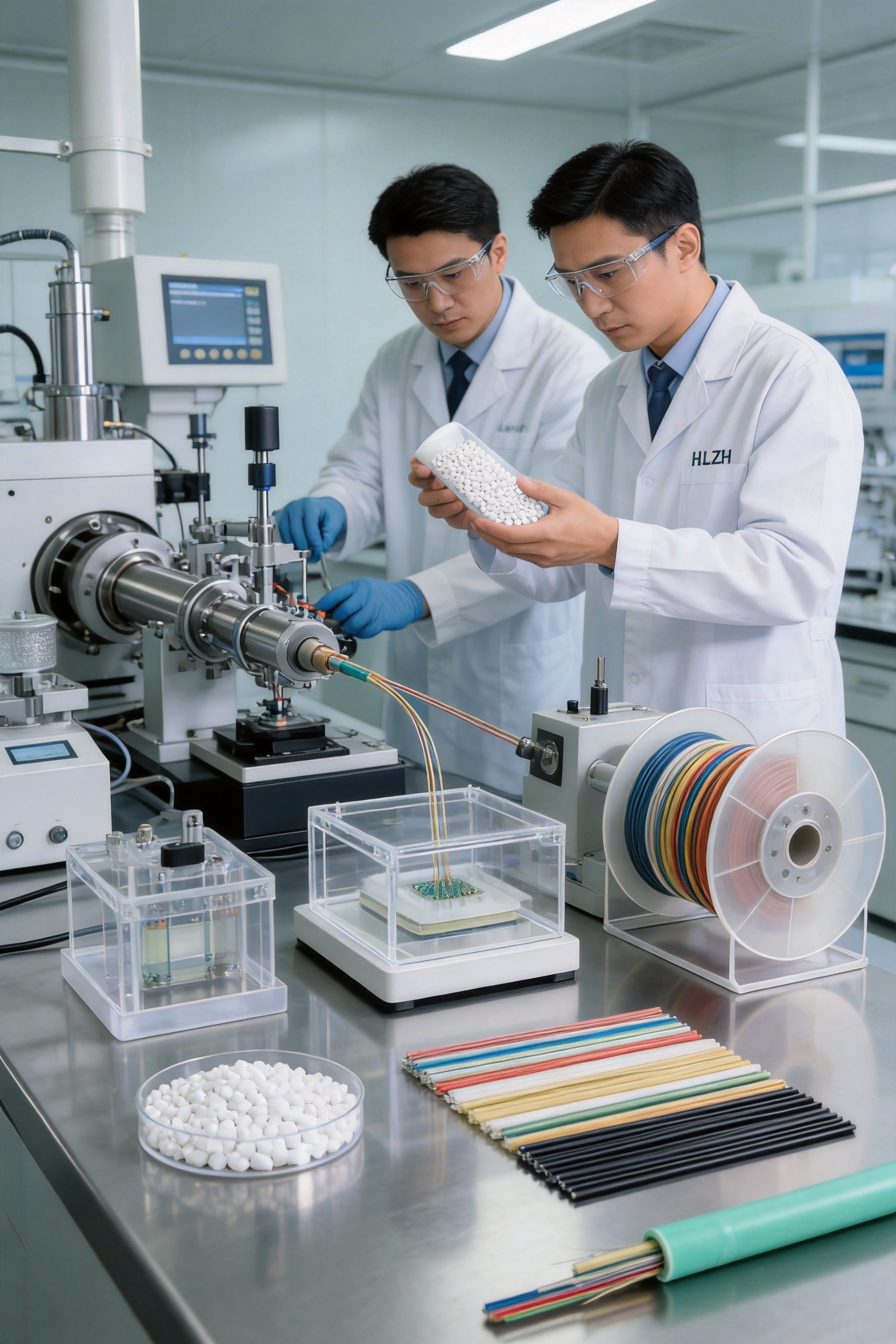
Modern communication networks depend on optical fiber cables that can deliver high bandwidth, low signal attenuation, mechanical durability, and reliable long-term performance in demanding indoor environments. As data centers, telecommunications facilities, base stations, enterprise networks, and smart buildings continue to expand, cable materials must provide more than basic insulation and flame resistance. They must also support efficient production, stable optical performance, environmental responsibility, and dependable operation throughout the service life of the cable.
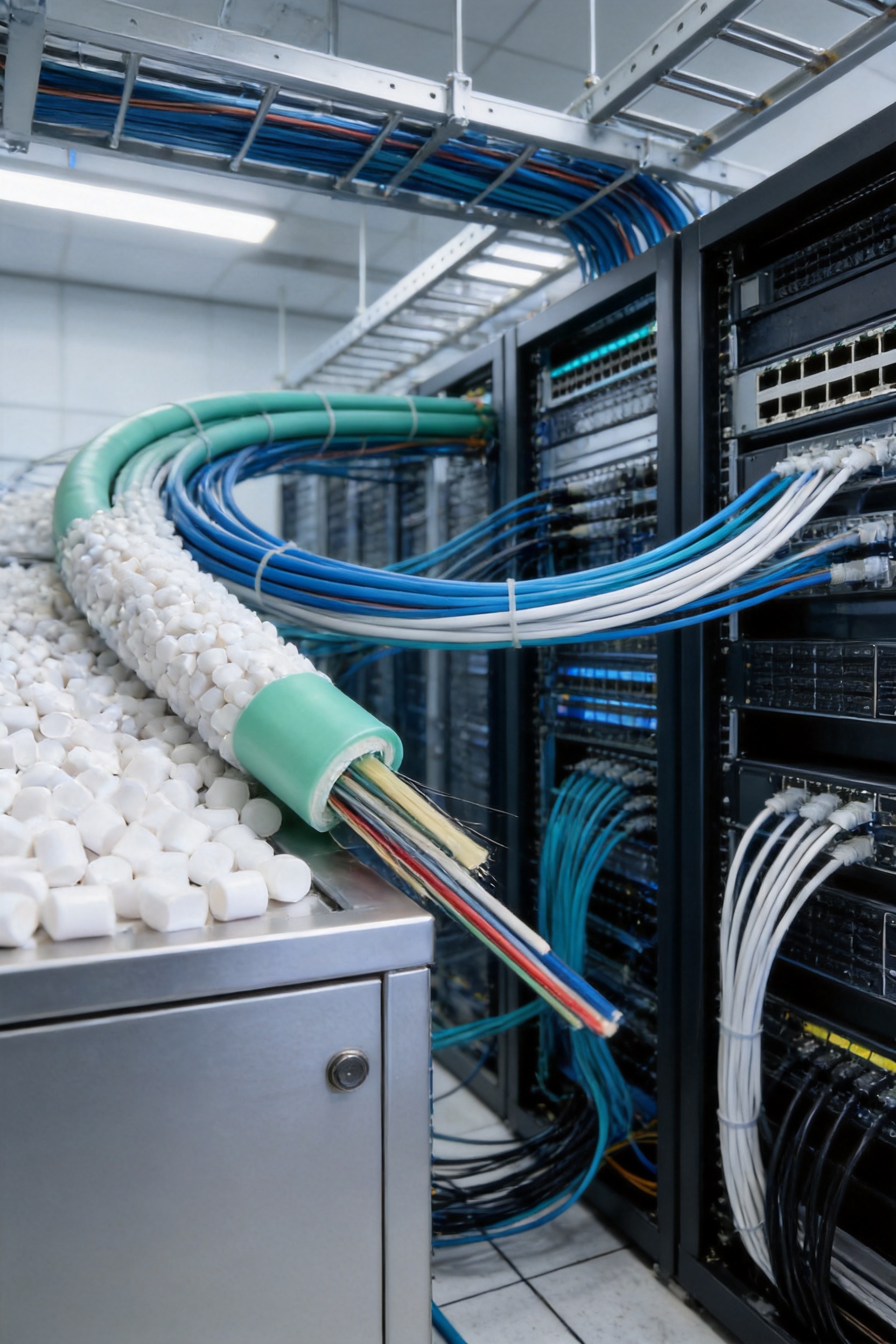
The tight-buffered material described in this article is a thermoplastic low-smoke zero-halogen, or LSZH, compound developed for the secondary coating of optical fibers. It is designed for indoor optical cables, data center jumper cables, and base station pull cables. The compound combines low thermal shrinkage, low thermal deformation, low additional optical loss, good toughness, smooth extrusion behavior, and flame-retardant performance in a material platform intended for high-density communication cabling.
Its formulation is based on environmentally friendly flame-retardant particles and a carefully balanced polymer system. The result is a material that can help cable manufacturers address several common challenges at the same time: maintaining fiber protection without excessive stiffness, limiting dimensional changes during temperature fluctuations, reducing the risk of optical loss caused by mechanical or thermal stress, and achieving stable processing on industrial extrusion equipment.
Manufactured by Jiangsu Duoshang New Materials Technology Co., Ltd., the compound is supported by dedicated research and development capabilities, multiple production lines, application-oriented testing, and experience in polyolefin cable compounds. The available typical values show a strong balance between mechanical properties, electrical insulation, flame performance, low-smoke behavior, and resistance to environmental stress cracking.
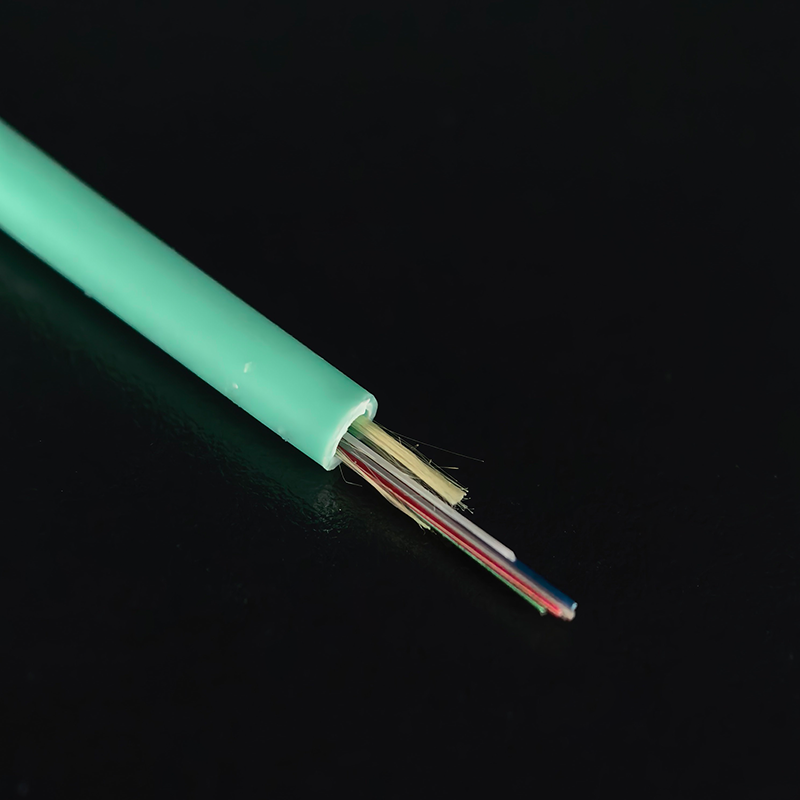
Tight-Buffered Material for Optical Fibers in Communication and Data Centers
Product Role in Optical Fiber Cable Construction
In a tight-buffered optical fiber design, a protective polymer layer is applied directly around the coated optical fiber. This layer provides mechanical protection and creates a manageable cable element that can be handled, routed, terminated, and connected during installation. The material must be sufficiently tough to withstand handling while remaining flexible enough for bending and routing in crowded communication spaces.
The secondary coating also influences the relationship between the optical fiber and the surrounding cable structure. Excessive shrinkage, deformation, or internal stress can affect the fiber and potentially contribute to additional optical attenuation. For this reason, a compound used in tight-buffered construction must be carefully engineered for thermal stability and dimensional consistency.
Unlike general-purpose plastic compounds, an optical fiber tight-buffering material must satisfy a demanding combination of requirements. It must flow consistently through the extrusion die, form a smooth and uniform layer, adhere appropriately to the intended structure, maintain its physical properties after aging, and resist cracking under temperature and environmental exposure. At the same time, it must meet the low-smoke and halogen-free expectations associated with modern indoor cable systems.
The product is categorized as a thermoplastic LSZH sheathing compound. This means it is processed through heating and extrusion rather than through an in-line chemical cross-linking reaction. Thermoplastic processing can offer production flexibility, efficient line operation, and the possibility of reprocessing production scrap under controlled manufacturing conditions. For cable producers, these characteristics can support productivity and simplify the management of different cable constructions.
Main Product Advantages
Low Thermal Shrinkage and Low Thermal Deformation
Temperature changes during extrusion, cooling, storage, installation, and operation can cause polymer materials to contract or deform. In an optical fiber cable, uncontrolled dimensional change can increase stress on the fiber or change the geometry of the cable element. The typical thermal deformation values for the three listed grades are 3%, 5%, and 6% after testing at 90 degrees Celsius for one hour, against a stated requirement of no more than 20%.
These results indicate a useful margin relative to the listed limit. Low thermal deformation can help the finished cable maintain a more stable structure when exposed to elevated temperatures. It may also support more consistent cable dimensions, improved handling, and reduced risk of uneven pressure around the optical fiber.
The material is also described as having low thermal shrinkage. Although a separate shrinkage value is not provided in the supplied specification table, this design characteristic is important for tight-buffered applications. Lower shrinkage can help reduce post-extrusion dimensional changes and limit the transmission of unwanted mechanical stress to the optical fiber.
Low Additional Optical Loss
Optical fiber systems are designed to transmit signals with minimal attenuation. The fiber itself is only one part of the performance equation; the surrounding coating and cable construction can also affect signal stability. If a tight-buffering material changes dimensions significantly, applies uneven pressure, or responds poorly to temperature cycling, additional optical loss may occur.
The product has been developed with low additional optical loss as a key application objective. Its balance of toughness, thermal stability, and extrusion uniformity is intended to help manufacturers produce a consistent buffer around the fiber. A stable buffer geometry can contribute to predictable cable performance, especially in dense data center installations where many cables may be routed through confined spaces and exposed to repeated handling.
It is important to distinguish the compound’s contribution from the complete cable’s optical performance. Final attenuation and transmission characteristics depend on the optical fiber, coating design, extrusion conditions, cable geometry, installation method, and environmental exposure. Nevertheless, a low-stress, dimensionally stable buffering compound provides an important foundation for reliable cable engineering.
Good Toughness and Mechanical Protection
The listed tensile strength values are 13 MPa, 12.5 MPa, and 12 MPa for DS-WDZGL-T0, DS-WDZGL-T1, and DS-WDZGL-T2, respectively. The stated standard is 10 MPa. Elongation at break is listed as 170%, 230%, and 250%, compared with a stated minimum of 150%.
These values show that the grades are not designed merely to be rigid protective layers. They provide a degree of ductility that can help the buffer tolerate bending, pulling, routing, and ordinary handling during cable assembly and installation. Higher elongation can be particularly useful when cables pass around cabinets, patch panels, distribution frames, and other equipment with limited routing space.
Good toughness can also reduce the likelihood of damage during stripping and termination. While the correct stripping tools and procedures remain essential, a material with balanced strength and elongation can support practical field operations. The appropriate grade should be selected according to the cable design, required hardness, processing conditions, and end-use environment.
Low-Smoke Zero-Halogen Flame-Retardant Design
Indoor communication cables are often installed in occupied buildings, equipment rooms, raised-floor spaces, vertical shafts, and data centers. In these environments, fire behavior and smoke generation are critical considerations. Halogen-containing materials may generate corrosive gases when exposed to fire. LSZH compounds are designed to reduce halogen acid gas emissions and limit smoke-related hazards compared with conventional halogenated cable materials.
The supplied test data show a halogen acid gas content of 0% for all three listed grades, against a stated maximum of 0.5%. The pH values are 5.2, 5.1, and 5.3, compared with a stated minimum of 4.3. These results support the product’s low-halogen-acid-gas positioning and indicate that the formulation is designed for applications where low corrosivity and improved fire safety are important.
Smoke density is listed separately for flameless and flaming conditions. Under flameless conditions, the typical values are 228 and 242 for the first two grades, against a stated limit of 250; the third grade is marked with a dash in the supplied data. Under flaming conditions, the listed values are 70, 65, and 60, against a stated limit of 100.
The oxygen index values are 38% for DS-WDZGL-T0 and 33% for DS-WDZGL-T1, compared with a stated minimum of 32%; the value for DS-WDZGL-T2 is not listed. These results show that the grades are formulated to support flame resistance while maintaining the processing behavior required for a thermoplastic cable compound.
Actual fire performance depends on cable diameter, wall thickness, conductor or fiber arrangement, processing quality, and the test method used for the finished cable. Cable manufacturers should validate the completed construction against the regulations and standards applicable to the target market.
Typical Technical Data
| No. | Property | Unit | Stated Standard | DS-WDZGL-T0 | DS-WDZGL-T1 | DS-WDZGL-T2 |
|---|---|---|---|---|---|---|
| 1 | Density | g/cm³ | Not specified | 1.50 | 1.44 | 1.48 |
| 2 | Tensile strength | MPa | 10 | 13 | 12.5 | 12 |
| 3 | Elongation at break | % | 150 | 170 | 230 | 250 |
| 4 | Tensile strength change after thermal aging at 100°C for 168 hours | % | ±20 | +12 | +7 | +8 |
| 4 | Elongation change after thermal aging at 100°C for 168 hours | % | ±20 | -10 | -5 | -9 |
| 5 | Environmental stress cracking resistance, F0, 96 hours | Pieces | 0/10 | Pass | Pass | Pass |
| 6 | Thermal deformation at 90°C for 1 hour | % | ≤20 | 3 | 5 | 6 |
| 7 | Low-temperature brittleness temperature | °C | -25 | Pass | Pass | Pass |
| 8 | Volume resistivity at 20°C | Ω·m | ≥10¹⁰ | 1.7 × 10¹¹ | 4.5 × 10¹¹ | 3.6 × 10¹¹ |
| 9 | Thermal shock resistance at 130°C for 1 hour | Visual result | No cracking | No cracking | No cracking | No cracking |
| 10 | Smoke density, flameless | Test value | ≤250 | 228 | 242 | Not listed |
| 10 | Smoke density, flaming | Test value | ≤100 | 70 | 65 | 60 |
| 11 | Oxygen index | % | ≥32 | 38 | 33 | Not listed |
| 12 | Halogen acid gas content | % | ≤0.5 | 0 | 0 | 0 |
| 13 | pH value | pH | ≥4.3 | 5.2 | 5.1 | 5.3 |
| 14 | Conductivity | As supplied | As supplied | 1.3 | 1.5 | 1.3 |
The table presents the typical values supplied for the three grades. It should be used for product comparison and preliminary material selection rather than as a substitute for a formal product specification, quality agreement, or finished-cable qualification. Test methods, conditioning requirements, sample geometry, and laboratory procedures can influence measured results.
Grade Selection Considerations
The three grades provide different combinations of density, tensile strength, elongation, and flame-related performance. DS-WDZGL-T0 has the highest listed tensile strength and oxygen index, together with a density of 1.50 g/cm³. DS-WDZGL-T1 has the lowest density at 1.44 g/cm³ and provides 230% elongation at break. DS-WDZGL-T2 provides the highest listed elongation at break at 250% and a tensile strength of 12 MPa.
A cable manufacturer seeking a stronger buffer may begin evaluation with DS-WDZGL-T0. A design prioritizing lower density and increased flexibility may consider DS-WDZGL-T1. A construction requiring high elongation and a more accommodating mechanical response may evaluate DS-WDZGL-T2. These are starting points rather than universal recommendations, because final selection must consider extrusion equipment, die design, cable dimensions, stripping requirements, installation conditions, and the relevant compliance targets.
All three grades pass the supplied low-temperature brittleness test at -25°C and show no cracking in the listed thermal shock test at 130°C for one hour. This common performance provides a useful baseline for indoor and protected communication applications that may experience temperature variation during transport, storage, installation, or operation.
Processing and Extrusion Performance
One of the product’s central advantages is its good extrusion fluidity. A tight-buffering material must melt and flow consistently through the extrusion system, die, and cooling section. Poor flow can lead to surface defects, uneven wall thickness, unstable dimensions, excessive die pressure, or inconsistent centering around the fiber.
Stable processing begins with appropriate material preparation. The compound should be stored in a clean, dry environment and protected from contamination. Before production, the cable manufacturer should confirm the recommended drying requirements, processing temperature range, screw configuration, die design, line speed, cooling conditions, and dimensional targets through a controlled trial. These parameters may vary according to the grade and the specific extrusion equipment.
A well-controlled extrusion process can help produce a smooth surface and uniform buffer thickness. Consistent feeding and melt temperature management are especially important for LSZH formulations containing flame-retardant components. Excessive shear, unsuitable residence time, or uncontrolled temperature can affect melt behavior and product appearance.
During line setup, manufacturers should monitor melt pressure, melt temperature, line speed, fiber tension, buffer diameter, concentricity, surface finish, and cooling-water conditions. Online dimensional measurement can provide early warning of process drift. Regular sampling should verify tensile strength, elongation, thermal deformation, shrinkage, and other properties required by the cable design.
The material’s thermoplastic nature can support efficient production and grade changes when the extrusion line is properly cleaned and managed. The actual changeover procedure should be determined by the processor, since flame-retardant compounds may require special attention to purging, residue control, screen-pack selection, and equipment maintenance.
Advantages Compared with Conventional Alternatives
Compared with Halogenated Sheathing Materials
The most obvious advantage over conventional halogenated materials is the low-smoke zero-halogen design. The listed halogen acid gas content is 0% for all three grades, and the pH values satisfy the stated requirement. This makes the compound more suitable for indoor applications where smoke, corrosive gases, and equipment contamination are important concerns.
In a fire event, reducing corrosive emissions can help protect sensitive electronic equipment and may improve conditions for evacuation and emergency response. The material’s low-smoke orientation also aligns with the needs of data centers and communication rooms, where equipment density is high and cable volumes can be substantial.
Compared with General-Purpose Polyolefin Compounds
General-purpose polyolefin materials may offer basic flexibility and insulation, but they are not necessarily optimized for optical fiber tight-buffering. The product described here is specifically developed for secondary coating of optical fibers. Its design priorities include low thermal deformation, low additional optical loss, suitable toughness, environmental stress cracking resistance, and smooth extrusion.
This application-specific balance can reduce the amount of reformulation or trial-and-error required when a cable manufacturer develops an indoor optical cable. Instead of selecting a general polymer and adding separate performance adjustments, the manufacturer can evaluate a compound designed around the mechanical, thermal, electrical, and flame-retardant demands of optical fiber protection.
Compared with Highly Rigid Protective Materials
Highly rigid materials may provide strong dimensional support, but excessive stiffness can make cable routing and termination more difficult. It can also increase bending stress during installation. The three listed grades provide elongation at break from 170% to 250%, demonstrating a flexible and tough material profile rather than a brittle protective shell.
This balance is especially relevant in data centers, where patch cords and jumper cables may be repeatedly moved, bent, bundled, and connected. A buffer material that combines mechanical protection with substantial elongation can support easier handling while maintaining a stable protective layer around the fiber.
Compared with Materials with Limited Thermal Stability
Materials with high thermal deformation or poor thermal shock resistance may change shape or develop defects when exposed to heat. The listed grades show thermal deformation of 3% to 6% at 90°C for one hour and no cracking after the stated 130°C thermal shock test. These results indicate a favorable thermal stability profile for the intended cable applications.
Lower deformation can support more consistent cable geometry during production and service. It may also reduce concerns associated with temperature-induced pressure changes around the fiber. As with all material comparisons, performance must be confirmed in the complete cable because the surrounding structure and manufacturing process also influence thermal behavior.
Application in Data Centers
Data centers require compact, organized, and dependable cabling systems. Optical cables may be routed through overhead trays, underfloor systems, cabinets, patching areas, and high-density equipment rows. The cable material must support rapid deployment while maintaining mechanical and fire-safety performance.
The tight-buffered LSZH compound is suitable for data center jumper cables and indoor optical cables because it combines flexibility with protection. Its low additional optical loss objective is relevant to high-bandwidth links, while its low-smoke zero-halogen formulation is appropriate for enclosed technical spaces containing valuable electronic equipment.
High-density cabling also creates challenges related to heat, bend radius, airflow, and maintenance access. A material with low thermal deformation can help maintain the designed cable shape when exposed to elevated temperatures. Good extrusion fluidity can support precise dimensions, which may help cable designers control outer diameter and routing density.
For patch cords and jumper cables, the material must also work well with stripping and connectorization operations. A consistent buffer structure can improve process repeatability, although connector manufacturers and cable assemblers should confirm compatibility with their particular tools, adhesives, boot designs, and termination methods.
Application in Base Station Pull Cables
Base station cable systems may be installed in equipment rooms, vertical routes, outdoor cabinets, or partially exposed locations depending on the network architecture. Pull cables can experience mechanical tension, bending, temperature change, and repeated handling during installation.
The product’s tensile strength and elongation characteristics provide a useful foundation for cable designs that need both protection and flexibility. Its environmental stress cracking resistance results are also relevant where the cable may face mechanical strain in combination with environmental exposure.
The low-temperature brittleness test indicates that the grades pass at -25°C. This can be useful for cable designs that may be transported or installed in cool climates. However, the complete cable system should be evaluated for the actual minimum and maximum temperatures, ultraviolet exposure, moisture, chemical contact, and mechanical loads expected in the field.
Environmental Stress Cracking and Long-Term Reliability
Environmental stress cracking occurs when a polymer exposed to mechanical stress and a challenging environment develops cracks or premature failure. In cable applications, cracking can compromise the protective layer and expose the underlying fiber or structure.
All three listed grades pass the F0 environmental stress cracking resistance test for 96 hours, with a stated criterion of zero failures out of ten pieces. This result supports the compound’s suitability for applications where mechanical durability and resistance to cracking are important.
Thermal aging results also show controlled property changes. After aging at 100°C for 168 hours, tensile strength changes are listed as +12%, +7%, and +8%, while elongation changes are -10%, -5%, and -9%. These values fall within the stated ±20% range. The results indicate that the grades retain a useful balance of strength and flexibility after the specified accelerated aging exposure.
Accelerated aging is not identical to real-world service aging. Cable manufacturers should perform additional qualification under the temperature, humidity, chemical, mechanical, and electrical conditions applicable to the intended installation. Nevertheless, the supplied results provide evidence that the material has been evaluated for property retention under elevated temperature exposure.
Electrical Insulation Properties
Although the primary purpose of a tight-buffered optical fiber material is mechanical and environmental protection rather than electrical conduction, electrical insulation properties remain relevant in many cable systems. The volume resistivity values at 20°C are listed as 1.7 × 10¹¹ Ω·m, 4.5 × 10¹¹ Ω·m, and 3.6 × 10¹¹ Ω·m, compared with a stated minimum of 10¹⁰ Ω·m.
These values indicate high electrical resistance under the reported test condition. This characteristic can support insulation performance in hybrid cable structures, communication installations with nearby electrical systems, and applications where surface or volume conductivity must be controlled.
The supplied table lists conductivity values as 1.3, 1.5, and 1.3 with the unit presentation shown as Mv/m and μS/mm. Because the unit formatting is not fully clear, cable manufacturers should request the formal test method and confirmed unit before using these values for design calculations or compliance documentation.
Manufacturing Strengths and Technical Support
Jiangsu Duoshang New Materials Technology Co., Ltd. specializes in the research, development, production, and sales of polyolefin cable compounds. Its product range includes thermoplastic LSZH flame-retardant compounds, polyethylene sheath compounds, UV-crosslinked materials, silane cross-linkable materials, irradiation cross-linked materials, and other specialized cable materials.
The company operates a research and development center of more than 3,000 square meters. The center is equipped with research equipment valued at more than RMB 35 million and supported by a professional research and development team of more than 30 members. The team includes five doctors and personnel recognized through provincial and municipal talent programs.
This research infrastructure is important for a specialized material such as tight-buffered LSZH compound. Product development requires more than polymer blending. It involves flame-retardant formulation, rheological control, mechanical testing, thermal aging, electrical testing, extrusion trials, and application validation. A dedicated research team can connect laboratory results with actual cable manufacturing requirements.
The company operates two production bases covering more than 15,000 square meters, with more than ten production lines for polyolefin cable compounds. Multiple production lines can support manufacturing capacity, product variety, production scheduling, and supply continuity. For global cable manufacturers, stable availability is an important consideration alongside laboratory performance.
Duoshang also describes its services as including application-oriented solutions, research and testing support, technical documentation, stable supply capability, and customized material solutions. These capabilities can be valuable when a customer requires a compound adjusted for a particular buffer diameter, processing line, mechanical profile, flame performance target, or cable structure.
Quality Control and Product Qualification
Reliable LSZH compound production requires control of incoming raw materials, formulation accuracy, compounding temperature, dispersion quality, pelletizing, packaging, and storage. Flame-retardant particles must be distributed consistently throughout the polymer matrix. Inadequate dispersion may affect mechanical performance, surface quality, flame behavior, and extrusion stability.
Quality control should include checks of appearance, density, melt behavior, mechanical properties, thermal aging, thermal deformation, electrical resistivity, smoke performance, and halogen acid gas behavior as applicable. Production batches should be traceable so that any variation can be investigated and managed.
For a cable manufacturer, incoming inspection may include pellet appearance, moisture condition, lot identification, density, tensile strength, elongation, and extrusion trial results. A formal quality agreement can define acceptance criteria, sampling frequency, documentation, packaging requirements, and procedures for handling nonconforming material.
Finished cable qualification remains essential. The compound’s typical values do not automatically certify every cable design. The cable manufacturer must evaluate the complete product using the test methods and regulatory requirements applicable to the target market and application.
Recommended Evaluation Procedure for Cable Manufacturers
The first step is to define the cable application. Important parameters include indoor or outdoor use, required operating temperature, minimum installation temperature, desired buffer diameter, stripping method, cable bend radius, flame and smoke requirements, optical fiber type, connector system, and target production speed.
The second step is to select one or more grades for trial. DS-WDZGL-T0 may be evaluated where higher tensile strength and a higher listed oxygen index are priorities. DS-WDZGL-T1 may be considered where lower density and high elongation are desirable. DS-WDZGL-T2 may be evaluated for designs requiring the highest listed elongation.
The third step is to conduct a controlled extrusion trial. The processor should record all relevant line parameters, including screw speed, melt temperature, die temperature, line speed, fiber tension, cooling conditions, buffer diameter, concentricity, surface finish, and process stability.
The fourth step is to test the buffered fiber and finished cable. Evaluation should include dimensional stability, shrinkage, thermal deformation, tensile and elongation properties, stripping behavior, bending performance, optical attenuation, environmental stress cracking, thermal aging, smoke, flame, and halogen-related performance as required.
The final step is to establish a production control plan. The plan should define acceptable process windows, routine inspection frequency, batch release criteria, material storage conditions, and corrective actions. This approach helps convert laboratory performance into reliable mass production.
Storage, Handling, and Processing Guidance
The compound should be stored in its original sealed packaging in a dry, clean, and protected location. Exposure to moisture, dust, oils, incompatible polymers, or other contaminants can affect extrusion behavior and product quality. Stock should be managed using lot identification and first-in, first-out principles where appropriate.
Before opening a package, the processor should inspect it for damage or contamination. Once opened, unused material should be resealed according to the supplier’s instructions. Any drying or preconditioning requirement should be confirmed through the formal technical data sheet, because the correct procedure depends on the material formulation and local production conditions.
Extrusion personnel should avoid excessive residence time and uncontrolled temperatures. Equipment should be cleaned before production, particularly when changing from a different polymer family or a strongly pigmented compound. Proper screen-pack and die maintenance can help prevent surface defects and pressure instability.
Because the material is intended for optical fiber buffering, fiber tension and centering deserve special attention. Even a well-designed compound may produce poor cable performance if the fiber is over-tensioned, the die is misaligned, or the cooling process causes uneven contraction. Material selection and process control must therefore be treated as one integrated engineering task.
Customization and Application Development
Different optical cable constructions may require different combinations of hardness, flexibility, tensile strength, elongation, flame performance, density, and stripping behavior. A compound suitable for a flexible jumper cable may not be ideal for a larger indoor distribution cable or a specialized base station assembly.
Application-specific customization may involve adjusting the polymer balance, flame-retardant package, rheological behavior, color system, hardness, extrusion response, or mechanical profile. Any modification should be verified through laboratory testing and production trials rather than evaluated only by nominal formulation differences.
Technical cooperation between the compound supplier and cable manufacturer can shorten development time. Sharing information about the extrusion line, fiber type, target dimensions, production speed, required standards, and field environment enables more meaningful material recommendations.
Why the Material Is Suitable for High-Density Networks
High-density networks place simultaneous demands on space efficiency, installation speed, optical reliability, and fire safety. A cable material must support small, manageable cable constructions without sacrificing protection. The tight-buffered LSZH compound addresses this balance through a combination of good extrusion fluidity, low thermal deformation, substantial elongation, and low-smoke zero-halogen performance.
Its application focus on optical fiber secondary coating differentiates it from broad-purpose sheathing products. The formulation is intended to help protect the fiber while maintaining a controlled and processable buffer structure. This can support the development of cables for data centers, telecommunications rooms, base stations, and other communication infrastructure.
The company’s research capacity, production base, material portfolio, and customization services further strengthen the product offering. Customers can evaluate a specific grade, request application support, and develop a production process based on measured performance rather than relying solely on generic polymer descriptions.
Q&A
What is this product used for?
It is a thermoplastic LSZH compound designed for the secondary coating or tight buffering of optical fibers. Typical applications include indoor optical cables, data center jumper cables, and base station pull cables.
What does LSZH mean?
LSZH means low smoke zero halogen. The material is formulated to limit smoke generation and halogen acid gas emissions during fire exposure. The supplied data list 0% halogen acid gas content for all three grades.
What are the available grades?
The listed grades are DS-WDZGL-T0, DS-WDZGL-T1, and DS-WDZGL-T2. They provide different combinations of density, tensile strength, elongation, and flame-related properties.
Which grade has the highest tensile strength?
DS-WDZGL-T0 has the highest listed tensile strength at 13 MPa. DS-WDZGL-T1 is listed at 12.5 MPa, and DS-WDZGL-T2 is listed at 12 MPa.
Which grade has the highest elongation at break?
DS-WDZGL-T2 has the highest listed elongation at break at 250%. DS-WDZGL-T1 is listed at 230%, and DS-WDZGL-T0 is listed at 170%.
Does the compound resist thermal deformation?
Yes. The listed thermal deformation values after one hour at 90°C are 3%, 5%, and 6%, compared with a stated maximum of 20%.
Can the compound be used in data centers?
It is developed for data center jumper cables and indoor optical cable applications. The low-smoke zero-halogen formulation, low additional optical loss objective, good toughness, and processing fluidity are relevant to high-density data center cabling.
Does it pass low-temperature testing?
All three listed grades pass the stated low-temperature brittleness test at -25°C. The actual cable should still be evaluated at the minimum temperature expected during transport, installation, and operation.
Does the compound provide electrical insulation?
Yes. The listed volume resistivity values at 20°C are above the stated minimum of 10¹⁰ Ω·m for all three grades.
Can the material be customized?
The supplier provides customized material solutions and application-oriented technical support. Customization requirements should be discussed in relation to the cable design, processing equipment, target properties, and applicable standards.
Are the listed values guaranteed for every production batch?
The values provided are typical values. A formal technical data sheet, quality agreement, and batch acceptance specification should be used to establish guaranteed limits and testing procedures.
Does the compound eliminate the need for finished-cable testing?
No. Finished-cable testing remains necessary because optical performance, flame behavior, mechanical properties, and dimensional stability depend on the complete cable construction and manufacturing process.
Conclusion
The tight-buffered thermoplastic LSZH compound is designed to meet the combined mechanical, thermal, processing, optical, electrical, and fire-safety demands of modern optical fiber cabling. Its key advantages include low thermal deformation, low thermal shrinkage, low additional optical loss, good toughness, strong extrusion fluidity, environmental stress cracking resistance, high volume resistivity, and low-smoke zero-halogen performance.
The three available grades offer different performance balances for cable manufacturers. DS-WDZGL-T0 emphasizes tensile strength and provides the highest listed oxygen index. DS-WDZGL-T1 offers lower density and high elongation. DS-WDZGL-T2 provides the highest listed elongation at break. This range allows engineers to begin material selection according to the requirements of a specific cable design.
Compared with conventional halogenated, general-purpose, overly rigid, or thermally unstable alternatives, the material provides a more application-focused solution for indoor optical fiber protection. Its value is reinforced by the manufacturer’s research facilities, technical team, production capacity, broad polyolefin compound portfolio, and customized application support.
For the best results, cable manufacturers should evaluate the compound through controlled extrusion trials and complete-cable qualification. When correctly selected and processed, the material can support reliable, compact, and environmentally responsible optical cabling for data centers, communication facilities, indoor networks, and base station applications.
References
1. Supplier-provided technical information for DS-WDZGL-T0, DS-WDZGL-T1, and DS-WDZGL-T2 tight-buffered optical fiber compounds.
2. Supplier-provided company information regarding research and development facilities, production bases, product categories, and application support.
3. General principles of thermoplastic extrusion for polymer cable compounds, including melt processing, dimensional control, cooling, and quality inspection.
4. General principles of low-smoke zero-halogen cable material evaluation, including smoke density, oxygen index, halogen acid gas content, pH value, and conductivity testing.
5. General optical fiber cable engineering principles concerning buffer geometry, thermal deformation, mechanical stress, bending, attenuation, and finished-cable qualification.