English
 Français
 Español
 русский
 عربى
Green Ohm
Green Ohm
Green Ohm
Green Ohm
Green Ohm
Green Ohm
Green Ohm
Green Ohm
Green Ohm
Content
Modern construction projects require cable insulation that does more than provide electrical separation. Cables installed in residential buildings, commercial complexes, transportation facilities, public infrastructure, and industrial structures must also control flame spread, limit smoke generation, reduce corrosive emissions, and maintain mechanical and electrical reliability throughout their service life. These requirements have increased demand for low-smoke zero-halogen, or LSZH, cable compounds with advanced flame-retardant performance.
UV Irradiation Cross-linked LSZH Flame Retardant Insulation for Construction Engineering, available in Class B1 and Class B2 grades, is developed to address these demanding requirements. The material combines a low-smoke, halogen-free formulation with rapid LED ultraviolet curing after extrusion. Unlike conventional irradiation cross-linking processes that may require long treatment cycles and substantial equipment investment, this technology can complete cross-linking within only a few seconds of UV exposure. The result is a highly efficient manufacturing route that supports continuous production, shortens processing cycles, and reduces energy consumption.
The material is designed for cable insulation applications in construction engineering and other environments where fire safety, smoke control, electrical performance, and processing efficiency are essential. Its performance profile includes high tensile strength, good elongation, stable heat resistance, excellent volume resistivity, strong dielectric performance, low smoke density, low acidity, low conductivity, and very low halogen acid gas content.
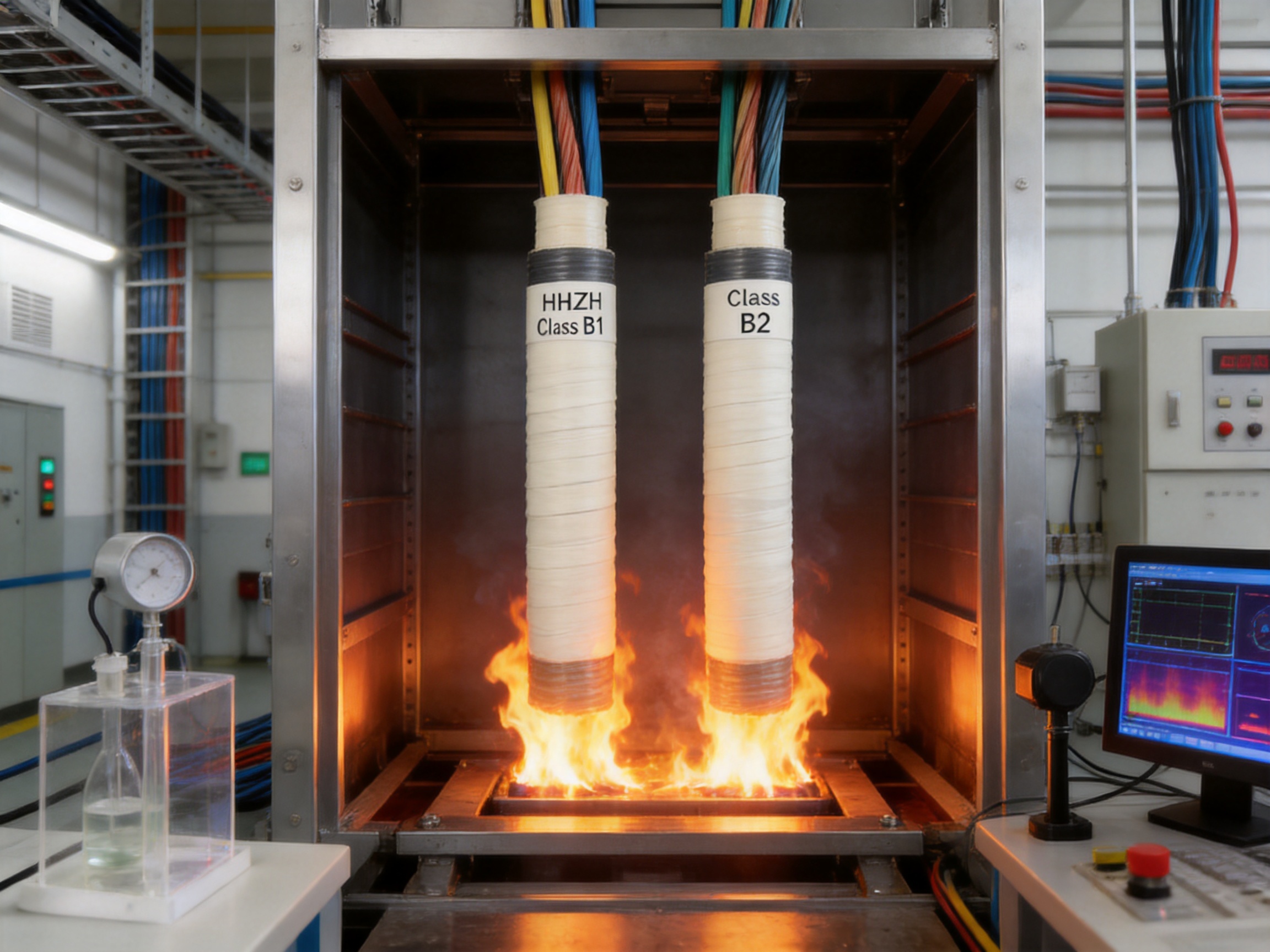
The Class B1 and Class B2 product grades are intended to meet the combustion performance requirements specified in GB 31247-2014. These requirements cover more than simple flame retardancy. They also consider flame propagation, heat release rate, total heat release, smoke density, burning droplets, combustion particulates, toxicity of combustion gases, and corrosiveness. This comprehensive approach makes the compound particularly suitable for projects where cable fire behavior is a major part of the overall building safety strategy.
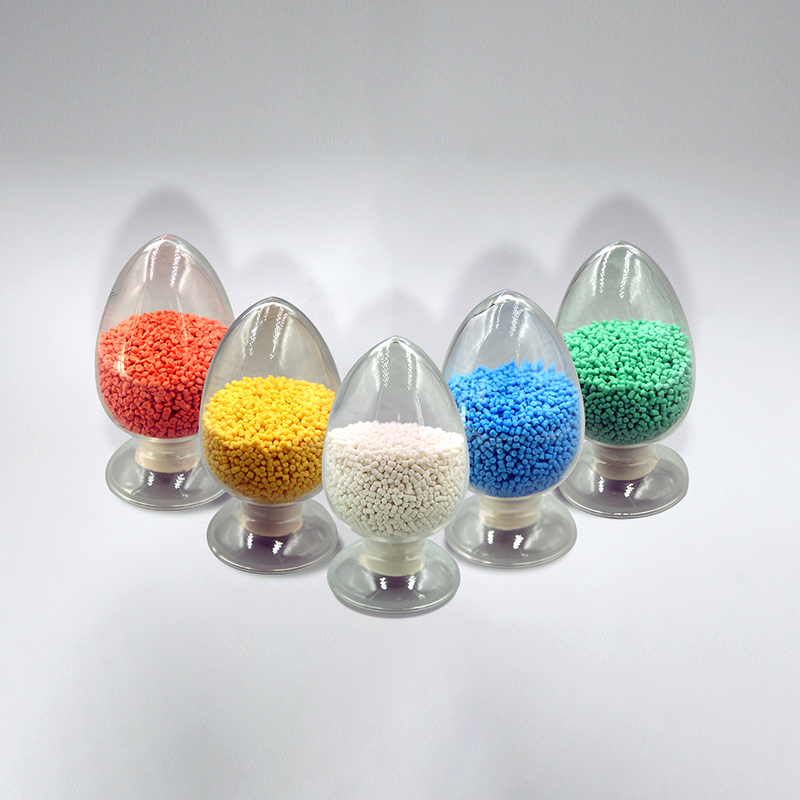
UV Irradiation Cross-linked LSZH Flame Retardant Insulation for Construction Engineering (Class B1/B2)
Why LSZH Insulation Matters in Construction Engineering
When a cable is exposed to fire, the insulation and sheath materials can influence the development of the incident in several ways. A conventional halogen-containing material may release dense smoke and acidic gases when it burns. These emissions can reduce visibility, hinder evacuation, corrode sensitive electrical equipment, and create additional risks for occupants and emergency personnel.
LSZH materials are formulated without intentionally added halogen elements that generate high levels of hydrogen chloride, hydrogen bromide, or similar corrosive gases during combustion. Their principal safety value is therefore not limited to preventing ignition. The material also aims to reduce the harmful secondary effects associated with cable fires.
In a building, smoke can travel well beyond the immediate location of the fire through cable trays, shafts, ceilings, service corridors, and ventilation pathways. A cable material with lower smoke generation can help preserve visibility and reduce the obstruction of escape routes. Low corrosiveness can also help protect switchgear, control systems, communication equipment, emergency systems, and other metal components from acid-related damage.
Construction projects often contain a large quantity of cable installed in concentrated areas. A cable fire in a high-density installation may produce a greater total volume of heat and smoke than a single isolated cable. For this reason, cable compound selection should consider not only electrical insulation performance but also the material’s contribution to fire development and smoke conditions.
The Class B1 and B2 LSZH formulation is positioned for applications where a higher level of combustion performance is required. The two classes allow cable manufacturers and project designers to select a suitable material according to the required fire classification, cable construction, installation environment, and applicable project specification.
Core Technology: UV Irradiation Cross-Linking
Cross-linking changes the structure of a polymer compound by forming connections between polymer chains. These connections improve resistance to heat, deformation, mechanical stress, and environmental conditions. For cable insulation, cross-linking is particularly important because the material may be exposed to elevated conductor temperatures, installation tension, bending, pressure, and long-term thermal cycling.
Traditional cross-linking technologies may rely on chemical reactions, moisture-assisted processes, heat treatment, or conventional irradiation equipment. Each approach has its own advantages and limitations. Some systems require long curing periods, extended storage, specialized production lines, or relatively high energy input. Others may involve complex equipment arrangements or strict control of processing conditions.
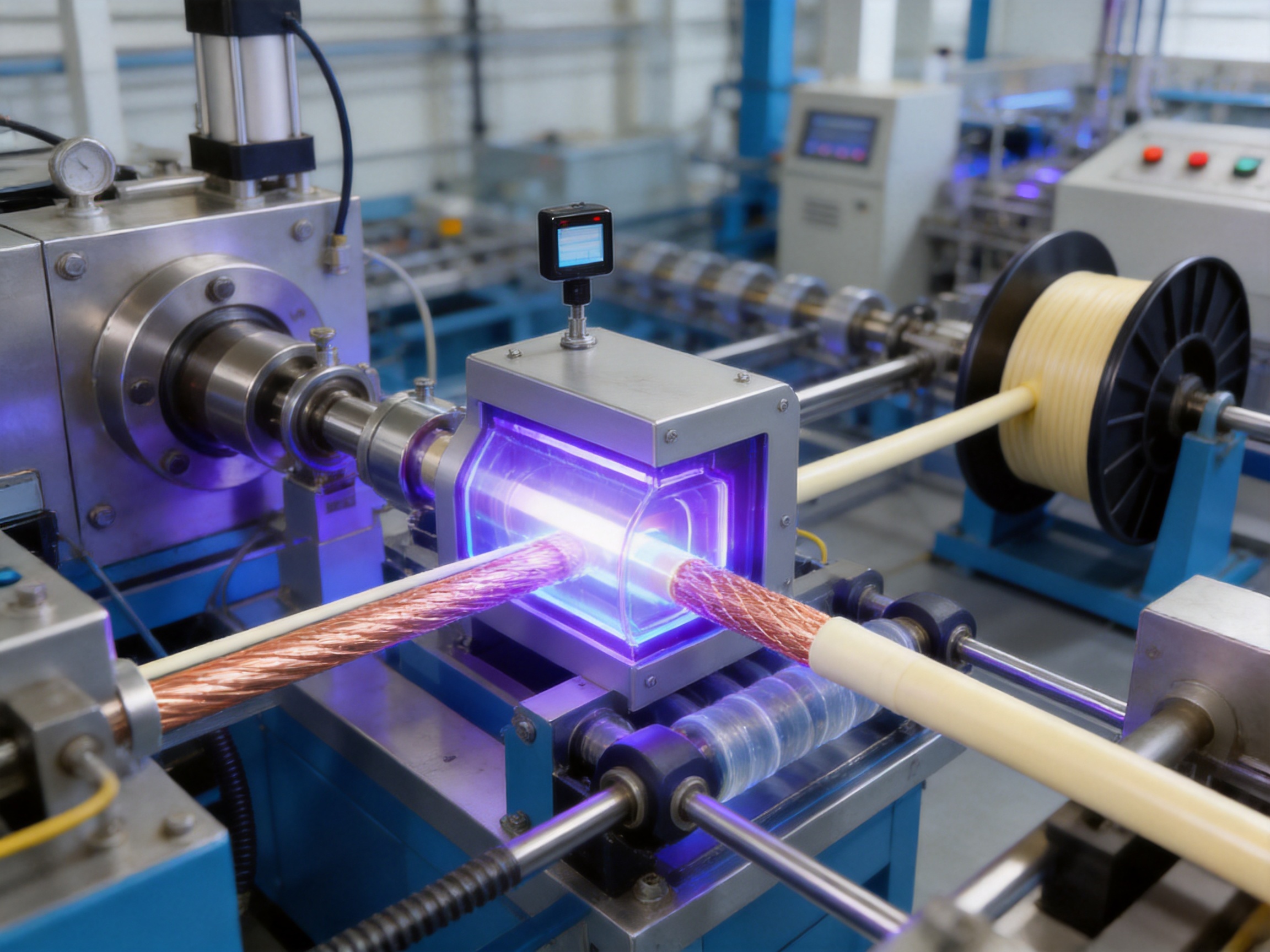
The UV irradiation method used for this LSZH compound is designed around rapid curing by LED ultraviolet light. After the insulation is extruded onto the conductor, the cable passes through a UV exposure area. The formulation is activated by the UV energy, and cross-linking is completed within a few seconds under suitable process conditions.
This curing speed can be dozens of times faster than traditional irradiation cross-linking methods. The high reaction speed supports a more compact and continuous production process. Extrusion and cross-linking can be carried out in a coordinated production sequence, reducing the time required between material application and finished cable handling.
LED UV curing also provides opportunities for controlled energy delivery. The light source can be arranged to provide stable, targeted irradiation, while the production line can be adjusted according to cable diameter, line speed, insulation thickness, and required cross-linking level. Such process control is important for maintaining uniform material performance across the entire cable length.
Short Curing Cycles
The most visible benefit of the technology is its short curing cycle. A conventional process may require additional treatment time after extrusion or may involve slower irradiation speeds. By contrast, rapid UV curing allows manufacturers to move more quickly from extrusion to subsequent cable operations such as cooling, testing, take-up, and packaging.
A shorter cycle can increase production capacity without necessarily requiring a proportional increase in floor space. It can also improve responsiveness to customer orders, especially where multiple cable sizes, colors, or material specifications must be produced in relatively small batches.
Lower Equipment Investment
The UV LED process can reduce the need for large, complex, or energy-intensive curing equipment. The equipment configuration remains dependent on cable construction and production scale, but the rapid curing principle can support a more compact manufacturing layout.
Lower equipment investment is important for cable manufacturers seeking to expand LSZH capacity or add a high-performance product line. Reduced capital requirements can improve the economic feasibility of upgrading production facilities while allowing manufacturers to focus investment on extrusion control, testing equipment, quality systems, and customer-specific development.
Lower Energy Consumption
Energy efficiency is another important advantage. Since UV curing takes place rapidly and energy is delivered directly through LED light, the process can reduce the energy associated with long thermal treatment cycles or extended irradiation periods. Lower energy consumption can help decrease manufacturing costs and support corporate sustainability objectives.
Energy savings are particularly meaningful in continuous cable manufacturing, where production lines can operate for long periods and process large volumes of material. Even a moderate reduction in energy use per meter can produce a substantial annual benefit at commercial production scale.
Continuous Extrusion and Cross-Linking
The material is designed to enable simultaneous extrusion and cross-linking in an integrated production flow. This helps reduce intermediate storage, repeated handling, and the risk of contamination or damage before curing is complete.
A continuous route can also improve production planning. Cable manufacturers may be able to shorten work-in-process time, increase line utilization, and simplify the movement of semi-finished products. When combined with in-line inspection and process monitoring, the integrated process can support more consistent quality from the first meter to the last.
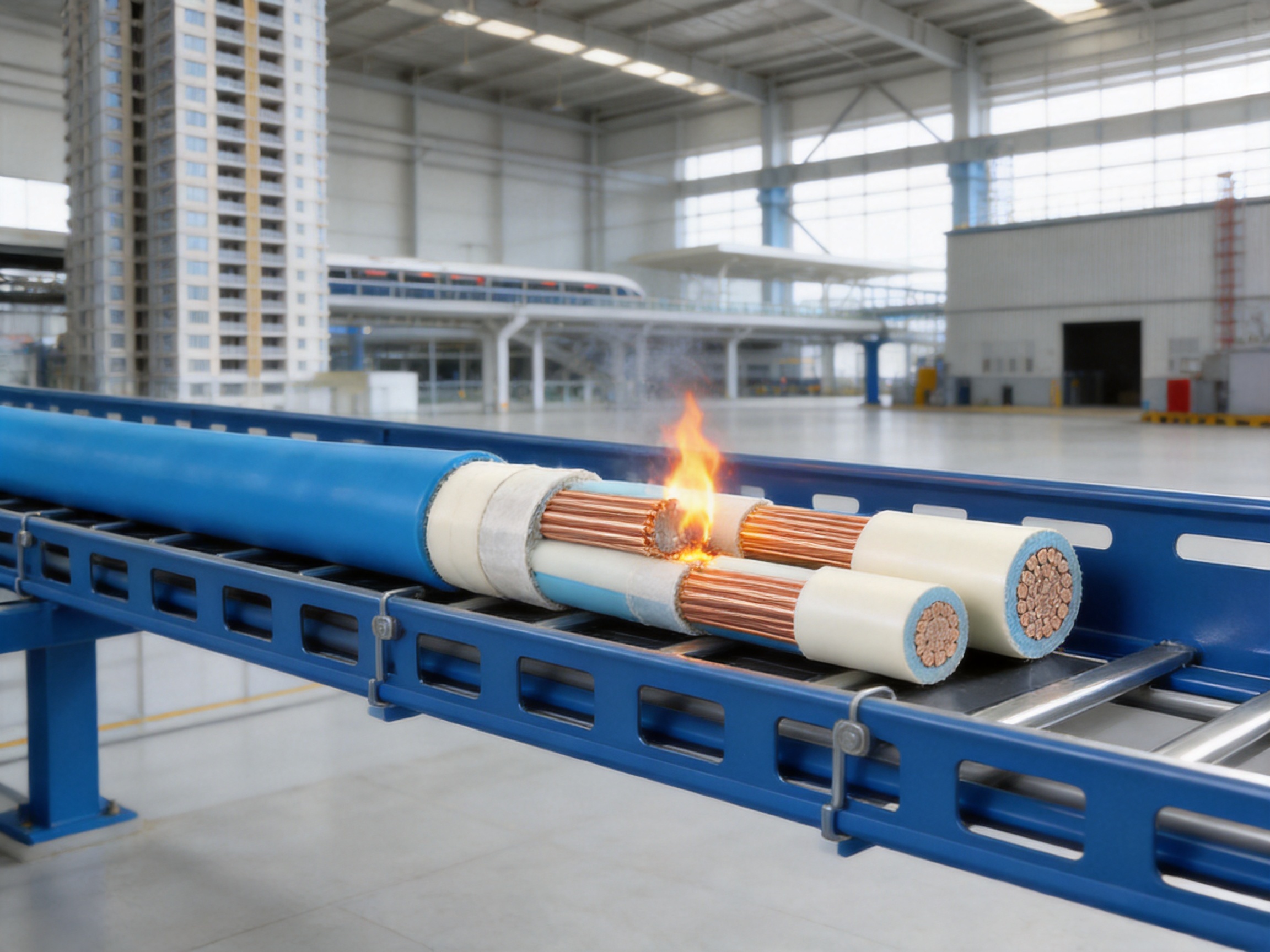
Fire Performance for Class B1 and Class B2 Applications
The Class B1 and Class B2 grades are developed for construction engineering applications that require defined combustion performance. The classification approach considers multiple fire-related properties rather than relying on a single flame test.
Important evaluation factors include the rate at which flame spreads along a cable installation, the amount of heat released during combustion, the total heat released, smoke density, the formation of burning droplets, combustion particulates, gas toxicity, and corrosive emissions. A material that performs well in one category but poorly in another may not provide balanced protection in a real fire scenario. The multi-factor design objective of these grades is therefore a significant feature.
The reported smoke density values demonstrate the compound